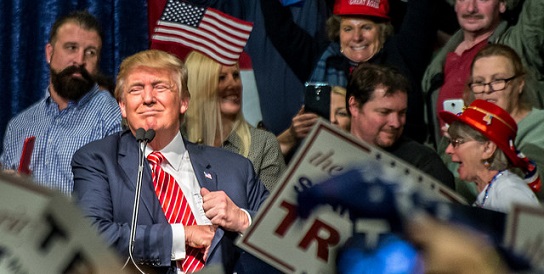
It’s no secret that the current presidential race boasts some very politically polarized candidates. Many of us bemoan the rise of these extremists and assume they reflect a growing divide in our country between left and right. After all, the goal of a representative democracy is to reflect the needs, beliefs, and priorities of the people, and so many assume that the widening ideological gap between the left and right in this race, and in Washington today, reflects a broader national trend among constituents. Are we right about that? A recent study (Westfall, Van Boven, Chambers, & Judd, 2015) found that the strength of one’s party affiliation leads people to overestimate political polarization. Essentially, the more partisan you are, the more partisan you assume the other side to be. Furthermore, people tend to view their own political group as rational and fact-based and the other group as attitudinal and ideological. So, Republicans might overestimate the degree of polarization on any given issue because they see their own argument as logic-based and the Democratic argument as visceral and morally motivated.
Ultimately, over-estimation of political polarization is not a new phenomenon. For example, students with partisan views have often overestimated the degree of polarization between the left and right on a myriad of issues including war, abortion. So, while it is true that actual polarization has increased over time, so have our perceptions of polarization, and the mismatch between actual and perceived polarization has stayed more or less the same.
What does this mean, practically speaking, for our democracy? Well, polarization has increased, though it is consistently overestimated. Furthermore, we know that individuals with partisan views, who tend to perceive polarization between the parties to be high, are more likely to be politically active and to devote time, energy, and resources to electing their candidates than those who don’t have partisan views. The result? Partisan candidates may be more likely to get nominated and elected than moderates, which, the authors predict, may perpetuate the cycle of polarization and inter-party acrimony.
References
Westfall, J., Van Boven, L., Chambers, J.R., & Judd, C.M. (2015). Perceiving Political
Polarization in the United States: Party Identity Strength and Attitude Extremity Exacerbate the Perceived Partisan Divide. Perspectives on Psychological Science 10(2), 145-158.
Photo credit:
 Darron Birgenheier Creative Commons Attribution 4.0 International License.